By Emily Parker
Updated November 2026
A push pull legs split calisthenics program groups bodyweight exercises by movement pattern: pushing, pulling and lower-body work. Done on three training days, each repeated twice a week, it can build upper-body strength, muscle and控制 without a single barbell. This guide gives you the exercise selection, weekly schedule, set and rep targets, and progression rules to follow it for the next 12 weeks.
What a Push Pull Legs Split Calisthenics Program Looks Like
The standard push pull legs structure sorts exercises by what they do. Push days train the chest, shoulders and triceps through pressing and dipping movements. Pull days train the back and biceps through rowing and pulling. Leg days train the quads, hamstrings, glutes and calves through squatting, hinging and single-leg work. Calisthenics swaps the usual machines and free weights for body-leverage exercises such as push-ups, dips, pull-ups, rows and pistol squats.
Shopping for one? See our guide: 7 Best Push Pull Legs Split Posters and Training Aids for 2026.
The split works well with bodyweight training for a simple reason: each movement pattern can be trained with a range of difficulty levels. A beginner can start with incline push-ups and table rows, then move up to archer push-ups and one-arm progressions as strength grows. Because each muscle group gets a dedicated day, you can recover between sessions while still training each area about twice a week.
For background on how this structure compares to other weekly layouts, see Push Pull Legs Workout Split for Beginners: A Step-by-Step Guide and Is a Push Pull Legs Split Effective? What Research and Programming Show.
Step 1: Assess Your Starting Level
Before choosing progressions, find out where you stand. Test each movement pattern once, using strict form and stopping one to two reps before failure. Record the numbers so you can measure progress later.
- Push-up: Maximum strict reps with a straight body line and chest reaching roughly fist height from the floor.
- Pull-up or australian row: Maximum strict reps. If you cannot do a pull-up, use a bodyweight row with feet on the floor and body at a 45-degree angle or more.
- Squat: Maximum bodyweight squats with full depth and heels down.
- Plank hold: Longest hold with neutral spine and no sagging hips.
Use these results to pick the starting progression for each exercise. A general guide: if you can do fewer than 8 strict push-ups, begin with incline push-ups; if you can do 15 or more, start with decline or deficit variations.
Step 2: Set Up Your Weekly Schedule
The most common layout is six training days: Push, Pull, Legs, then the same three again. Rest on the seventh day. If six days is too much, run a three-day version (Push, Pull, Legs with one rest day between each) and repeat the cycle over two weeks, or use a four-day version that trains legs once and the upper body twice.
| Day | Focus | Main Movements |
|---|---|---|
| Day 1 | Push | Push-ups, dips, pike push-ups, handstand or wall-supported work |
| Day 2 | Pull | Pull-ups or rows, chin-ups, inverted rows, scapular pulls |
| Day 3 | Legs | Squats, lunges, glute bridges, calf raises, core work |
| Day 4 | Push | Same as Day 1, slightly different variation |
| Day 5 | Pull | Same as Day 2, slightly different variation |
| Day 6 | Legs | Same as Day 3, slightly different variation |
| Day 7 | Rest | Mobility or walking only |
Step 3: Build Each Training Day
Each session should follow the same order: warm up, main strength movement, secondary movement, accessory work, then core. Keep the hardest exercise first while you are fresh.
Push Day Template
- Warm-up: 5 minutes of arm circles, scapular push-ups and 2 light sets of push-ups.
- Main: Decline or standard push-ups, 4 sets of 6 to 12 reps, rest 90 seconds.
- Secondary: Pike push-ups, 3 sets of 5 to 8 reps.
- Accessory: Bench dips or triceps dips, 3 sets of 8 to 12 reps.
- Core: Hollow body hold, 3 sets of 20 to 30 seconds.
Pull Day Template
- Warm-up: Dead hangs for 20 seconds, 3 times, plus band pull-aparts or light rows.
- Main: Pull-ups or negative pull-ups if needed, 4 sets of 4 to 8 reps, rest 2 minutes.
- Secondary: Inverted rows under a sturdy table or bar, 3 sets of 8 to 12 reps.
- Accessory: Chin-ups, 3 sets of 5 to 8 reps, or towel curls for grip.
- Core: Superman holds, 3 sets of 20 to 30 seconds.
Leg Day Template
- Warm-up: 5 minutes of hip circles, bodyweight squats and glute bridges.
- Main: Bulgarian split squats or regular bodyweight squats, 4 sets of 8 to 15 reps per leg.
- Secondary: Single-leg glute bridges, 3 sets of 10 to 15 reps per leg.
- Accessory: Calf raises on a step, 3 sets of 15 to 25 reps, pausing at the top.
- Core: Dead bugs, 3 sets of 8 to 12 reps per side.
Step 4: Apply Progressive Overload
Bodyweight training only builds muscle if the work gets harder over time. Progress through one of these methods in order of preference:
- Add reps: Work toward the top of your rep range before moving up.
- Increase leverage difficulty: Move from push-ups to decline push-ups, then to archer push-ups.
- Slow the tempo: Use a 3-second lowering phase on pull-ups and push-ups.
- Add pauses: Hold the bottom of a push-up or the top of a row for 2 seconds.
- Reduce rest: Cut rest from 90 seconds to 60 seconds once the set count is comfortable.
A simple rule: when you hit the top of the rep range for all sets in two consecutive sessions, move to the next progression step.
Step 5: Track Your Results for 12 Weeks
Run the program for 12 weeks, then retest the Step 1 benchmarks. Keep a training log with exercise, sets, reps, rest and any notes on how the session felt. Most people find that progress slows after the first few weeks, so use a deload week every fourth week: cut total sets by about 40 percent and keep the same movements.
Common Mistakes
- Skipping the leg day: Leg training is easy to neglect. Keep it on the schedule even when it feels less rewarding.
- Using momentum: Kipping pull-ups and bouncing push-ups reduce muscle tension. Pause at the bottom or top of each rep.
- Progressing too fast: Jumping to pistol squats before you can do full bodyweight squats leads to joint strain.
- Ignoring shoulder health: Pressing volume is high in this split. Include external rotation work and scapular control exercises.
- Training to failure every set: Stop with 1 to 2 reps in reserve on most sets to protect recovery.
Recommended gear
A few inexpensive tools make the program easier to run at home or in a park.
- Resistance bands (loop set): Useful for assisted pull-ups, band-resisted push-ups and warm-up work. View on Amazon
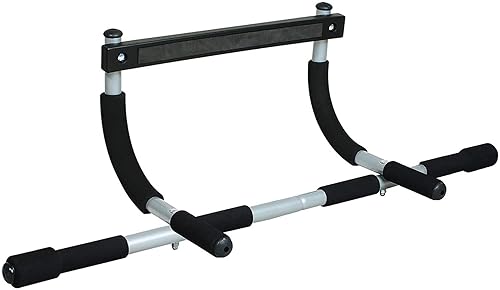
- Doorway pull-up bar: Lets you train pull days at home without a fixed rig. View on Amazon
- Parallette bars: Support dip and push-up variations and help build wrist strength. View on Amazon
- Exercise mat: Cushions knees and wrists during floor-based push and leg work. View on Amazon
FAQ
Can I build muscle with only calisthenics on a push pull legs split?
Yes, especially for beginners and intermediate trainees. Progressive overload through harder variations, added reps and slower tempo can stimulate meaningful muscle growth. Advanced lifters may need more load to keep progressing.
How many days a week should I train?
Six days (two cycles of push, pull, legs) is the classic setup. Three or four days work well for busy schedules, provided each muscle group still gets two sessions per week.
What if I cannot do a single pull-up?
Start with negative pull-ups, where you jump to the top and lower slowly for 3 to 5 seconds. Inverted rows and band-assisted pull-ups are also effective starting points.
How long until I see results?
Strength improvements often appear within 3 to 4 weeks. Visible changes in muscle size usually take 8 to 12 weeks of consistent training and adequate protein intake.
Should I train to failure?
Stopping with 1 to 2 reps in reserve on most sets is a practical target. Occasional sets to true failure are fine, but avoid making every set a grind.
Do I need to eat more protein?
Most people training for muscle benefit from roughly 1.6 to 2.2 grams of protein per kilogram of body weight daily. Consult a registered dietitian or physician if you have kidney disease or other medical conditions before changing your diet.
Is this program safe for people with shoulder problems?
Pressing and overhead movements can aggravate shoulder pain. If you have an existing injury, consult a physical therapist or doctor and modify exercises before starting.
Conclusion
A push pull legs split calisthenics program gives you a clear weekly structure, a wide range of progressions and a measurable path to stronger, more muscular training. Assess your starting level, follow the day templates, progress through the overload methods and retest after 12 weeks. Stay consistent, rest well and adjust the plan as your strength changes.
Related reading
- Women's Push Pull Legs 3-Day Split: A Step-by-Step Plan for Strength and Shape
- Upper/Lower vs Push Pull Legs Reddit: Which Split Should You Choose?
- Upper/Lower Split vs Push/Pull/Legs (2026): Which Is Better for Your Training?
- Push/Pull Legs Full Body 4 Day Split: A Step-by-Step Plan
Ready to choose one?
About Emily Parker
Emily Parker is part of our editorial team and reviews and edits our workout programs & splits guides, checking product details against manufacturer specifications and owner feedback.