As an Amazon Associate I earn from qualifying purchases. This page may contain affiliate links.
Amazing fitness workout routines are not defined by how exhausting they feel. They are the plans that match your current fitness level, your schedule and your goals, and then progress in a way you can actually sustain. This guide walks you through how to choose a routine, build one with proper sets, reps and progression, and avoid the mistakes that stall most people within a month. By the end, you will have a clear weekly plan and a method for making it harder over time.
Step 1: Define What “Amazing” Means for You
A routine that works for a competitive lifter may be useless for someone rebuilding fitness after a long break. Start by naming one primary goal and one secondary goal. Common pairings include strength plus muscle gain, general fitness plus fat loss, or endurance plus mobility.
Next, be honest about your available time. Most adults can sustain three to five sessions per week, each lasting 30 to 60 minutes. If your calendar only allows two sessions, a full-body plan will serve you better than a six-day split. For guidance on fitting training into real life, see Weekly Workout Schedules That Fit the Guidelines.
Set a measurable target
Pick one number you can track weekly. Examples include adding 5 pounds to your squat in eight weeks, completing 10 consecutive push-ups, or walking 30 minutes at a brisk pace four days per week. Setting Realistic Fitness Goals and Measuring Progress explains how to choose targets that are challenging without being discouraging.
Step 2: Choose the Right Routine Structure
Most effective routines fall into one of three structures. Each one fits a different training frequency.
- Full body (2 to 3 days per week): Trains every major muscle group in each session. Ideal for beginners and anyone with limited time. See Full Body Workout Routine: A Step-by-Step Plan for Beginners for a complete template.
- Upper/lower (4 days per week): Alternates upper-body and lower-body sessions. A good middle ground between volume and recovery.
- Push/pull/legs (5 to 6 days per week): Splits muscles by movement pattern, allowing high weekly volume. Better for intermediate trainees. A full breakdown is available in Push Pull Legs Workout Plan: 6-Day Split With Sets and Reps.
Step 3: Build Each Session With the Right Sets and Reps
Sets and reps should match your goal. The table below gives widely used starting ranges for adults with at least a few months of consistent training.
| Goal | Sets per exercise | Reps per set | Rest between sets | Effort (RIR) |
|---|---|---|---|---|
| Maximal strength | 3 to 5 | 3 to 6 | 2 to 4 minutes | 2 to 3 reps left |
| Muscle growth | 3 to 4 | 8 to 12 | 60 to 120 seconds | 1 to 3 reps left |
| Muscular endurance | 2 to 3 | 12 to 20 | 30 to 60 seconds | 3 to 4 reps left |
| General fitness | 2 to 3 | 8 to 15 | 60 to 90 seconds | 2 to 4 reps left |
RIR means “reps in reserve,” the number of additional reps you could have completed before failure. Stopping one to three reps short of failure keeps most people productive while limiting injury risk.
A sample full-body session
- Squat variation (goblet squat or back squat): 3 sets of 8 to 10
- Horizontal push (push-up or dumbbell bench press): 3 sets of 8 to 12
- Horizontal pull (dumbbell row or inverted row): 3 sets of 8 to 12
- Hip hinge (Romanian deadlift or glute bridge): 3 sets of 10 to 12
- Vertical push or pull (overhead press or pulldown): 2 sets of 8 to 12
- Core (plank or dead bug): 2 sets of 30 to 45 seconds
Warm up for five to ten minutes before lifting. A simple sequence is in Warm-Up Routines Before Strength or Cardio.
Step 4: Apply Progressive Overload
A routine stops working when your body no longer has a reason to adapt. Progressive overload solves this by gradually increasing demand. Use one of these methods at a time:
- Add reps: If you complete 3 sets of 8 with good form, aim for 3 sets of 9 next week.
- Add weight: Once you hit the top of your rep range for all sets, increase load by the smallest increment available, often 2.5 to 5 pounds for upper-body lifts and 5 to 10 pounds for lower-body lifts.
- Add sets: Increase from 3 to 4 sets once recovery is consistently good.
- Slow the tempo: A three-second lowering phase increases time under tension without adding load.
For bodyweight-focused routines, progression often means moving to harder variations. A push-up can progress to a decline push-up, then to a weighted or archer variation. Home Workouts With Bodyweight and Minimal Equipment covers progression ladders for common movements.
A simple four-week progression
| Week | Focus | Example (goblet squat) |
|---|---|---|
| 1 | Learn form, leave 3 reps in reserve | 3 x 10 at a moderate weight |
| 2 | Add reps within the range | 3 x 11 to 12 |
| 3 | Add load, reset to lower reps | 3 x 8 with heavier dumbbell |
| 4 | Consolidate, check recovery | 3 x 9 to 10 at that load |
Step 5: Plan Recovery and Adjust the Routine
Gains happen during recovery. Plan at least one full rest day per week, and keep at least 48 hours between sessions that hit the same muscles hard. Sleep seven to nine hours where possible, since it affects both recovery and motivation.
Review your routine every four to six weeks. If your lifts have stalled for three consecutive sessions, check sleep, nutrition and total volume before changing exercises. Changing movements too often is a common reason progress disappears.
Common Mistakes to Avoid
- Training to failure every set. This raises fatigue and injury risk. Keep most sets two to three reps short of failure.
- Skipping the warm-up. Even five minutes of light cardio and dynamic movement helps.
- Chasing too many exercises. Four to six well-chosen movements per session outperform a long list of rushed ones.
- Ignoring form to add weight. If reps look uncontrolled, drop the load.
- Changing the routine weekly. Give each plan at least four weeks before judging it.
- No plan for missed sessions. Decide in advance that you will shorten a workout rather than skip it entirely.
Tools and Setup Checklist
- A written or app-based log for weights, sets and reps
- A timer for rest periods
- Space for floor work and a sturdy anchor point if using bands
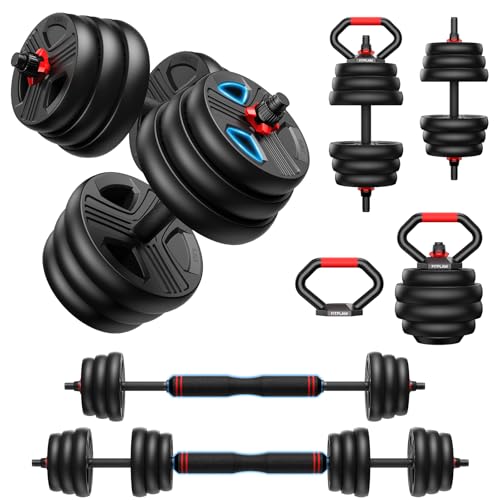
- One adjustable load option, such as dumbbells or a kettlebell
- A baseline test recorded before week one
Recommended gear
Equipment is optional, but a few items make progression easier to manage at home or in the gym.
- Adjustable dumbbells: Let you increase load in small steps without buying a full rack. Look for “adjustable dumbbell set” for options that match your weight range. View on Amazon
- Resistance bands: Useful for progressing pulls, presses and assisted movements when weights are limited. View on Amazon
- Kettlebell: Supports squats, hinges and carries in one tool. A reliable choice for full-body sessions. View on Amazon
- Yoga or exercise mat: Improves comfort for floor work, core training and stretching. View on Amazon
FAQ
How long should a fitness routine last before I change it?
Most routines need four to six weeks to produce measurable results. Change exercises only if you have a clear reason, such as pain or a stalled lift for several weeks.
How many days per week should I train?
Three full-body sessions suit most beginners. Intermediate trainees often do four to six days, depending on recovery and goals.
Do I need a gym to build an effective routine?
No. Bodyweight, bands and a single adjustable weight can cover all major movement patterns if you apply progressive overload.
How much rest should I take between sets?
Rest one to two minutes for hypertrophy work and two to four minutes for heavy strength sets. Shorter rests suit endurance-focused training.
Should I train when I am sore?
Light soreness is normal and training can continue. If soreness limits your range of motion or lasts more than a few days, reduce volume and check with a healthcare professional.
Is cardio necessary in a strength routine?
Cardio supports heart health and recovery. Two to three sessions of 20 to 30 minutes at a moderate pace are a practical starting point. Consult a doctor before starting if you have a heart condition or other health concerns.
How do I know if a routine is too hard?
Signs include form breakdown, declining performance across several sessions, poor sleep and persistent joint pain. Reduce volume or intensity for one to two weeks and reassess.
Can beginners use advanced routines?
It is better to start simple. Build a base with a full-body plan for at least eight to twelve weeks before moving to a split. For a beginner-friendly starting point, see Beginner Workouts: How to Start and Progress Safely.
Conclusion
Amazing fitness workout routines combine a clear goal, a structure that fits your schedule, sensible sets and reps, and steady progressive overload. Start with a full-body or upper/lower plan, track every session, and adjust only when the data tells you to. Consistency over several months will do more than any single intense week.