As an Amazon Associate I earn from qualifying purchases. This page may contain affiliate links.
Incredible fitness workout routines are not defined by exotic exercises or punishing sessions. They are programs that match your goals, fit your schedule, and progress in a way you can measure week to week. This guide walks you through six steps to build one, including a sample weekly plan with sets, reps and a clear progression scheme you can print and use right away.
Step 1: Define Your Goal and Training Age
Every effective routine starts with a specific objective. “Get fit” is too vague to program around. Choose one primary goal for the next 8 to 12 weeks, such as building muscle, improving strength on three lifts, increasing running endurance, or improving general conditioning. Then honestly rate your training experience. If you have less than six months of consistent lifting, you are a beginner and should prioritize technique and gradual load increases. If you have one to three years, you are intermediate and can handle more volume and more variety in rep ranges.
If you are unsure how to set measurable targets, the guide on Setting Realistic Fitness Goals and Measuring Progress explains how to write goals you can track.
Step 2: Choose a Training Split That Fits Your Week
A split is how you divide your training across the days you have available. The right split depends on how many sessions you can realistically complete, not on what looks impressive online.
- Two to three days per week: Full body workouts on alternating days. Each session hits all major muscle groups, and each muscle is trained two to three times weekly.
- Four days per week: Upper/lower split. Two upper days and two lower days, repeated.
- Five to six days per week: Push/pull/legs, or a hybrid. Push days cover chest, shoulders and triceps; pull days cover back and biceps; leg days cover quads, hamstrings, glutes and calves. For a detailed example, see Push Pull Legs Workout Plan: 6-Day Split With Sets and Reps.
Beginners usually do best with full body training, since it spreads practice across patterns and builds consistency. The Full Body Workout Routine: A Step-by-Step Plan for Beginners covers that structure in detail. For weekly scheduling, Weekly Workout Schedules That Fit the Guidelines shows how to place sessions around recovery.
Step 3: Select Exercises by Movement Pattern
Rather than collecting random exercises, organize each session around movement patterns. Pick one or two exercises from each category below:
- Squat or knee-dominant: back squat, goblet squat, leg press, lunges.
- Hinge or hip-dominant: Romanian deadlift, hip thrust, kettlebell swing.
- Horizontal push: bench press, push-up, dumbbell press.
- Vertical push: overhead press, landmine press.
- Horizontal pull: seated cable row, one-arm dumbbell row.
- Vertical pull: lat pulldown, pull-up or assisted pull-up.
- Core and carries: plank variations, farmer carries, Pallof press.
Compound lifts should come first in each session, when you have the most energy. Isolation work for arms, calves or rear delts can follow.
Step 4: Set Sets, Reps and Rest Periods
Use these working ranges as a starting point:
| Goal | Sets per exercise | Reps per set | Rest between sets |
|---|---|---|---|
| Strength | 3 to 5 | 3 to 6 | 2 to 4 minutes |
| Muscle building | 3 to 4 | 6 to 12 | 60 to 120 seconds |
| Endurance and conditioning | 2 to 3 | 12 to 20 | 30 to 60 seconds |
Most people should aim for 10 to 20 hard sets per muscle group per week across all sessions. A set is “hard” when you finish with one to three reps left in the tank.
Step 5: Build In Progression
A routine that never changes stops producing results. Use one of these progression methods and apply it consistently:
- Double progression: Choose a rep range, such as 8 to 12. Start at the low end with a weight you can control. When you hit the top of the range on every set, increase the load by the smallest increment available, then drop back to the bottom of the range.
- Linear progression: Add a small amount of weight each session, typically 2.5 to 5 pounds for upper body and 5 to 10 pounds for lower body, as long as you complete all prescribed reps with good form. This works well for beginners in their first few months.
- Weekly volume increase: Add one set to your main exercises every two weeks until you reach your weekly set target, then hold steady for a week before adjusting.
Sample Printable Weekly Plan (Upper/Lower, 4 Days)
| Day | Exercise | Sets x Reps |
|---|---|---|
| Day 1 (Upper) | Bench press | 4 x 6 to 10 |
| Day 1 (Upper) | One-arm dumbbell row | 4 x 8 to 12 |
| Day 1 (Upper) | Overhead press | 3 x 8 to 10 |
| Day 1 (Upper) | Lat pulldown | 3 x 10 to 12 |
| Day 2 (Lower) | Back squat | 4 x 5 to 8 |
| Day 2 (Lower) | Romanian deadlift | 3 x 8 to 10 |
| Day 2 (Lower) | Leg press | 3 x 10 to 15 |
| Day 2 (Lower) | Standing calf raise | 3 x 12 to 15 |
| Day 3 (Upper) | Incline dumbbell press | 3 x 8 to 12 |
| Day 3 (Upper) | Seated cable row | 3 x 10 to 12 |
| Day 3 (Upper) | Lateral raise | 3 x 12 to 15 |
| Day 3 (Upper) | Plank | 3 x 30 to 45 seconds |
| Day 4 (Lower) | Hip thrust | 4 x 8 to 12 |
| Day 4 (Lower) | Walking lunge | 3 x 10 per leg |
| Day 4 (Lower) | Leg curl | 3 x 10 to 12 |
| Day 4 (Lower) | Farmer carry | 3 x 40 yards |
Step 6: Warm Up, Recover and Review
Begin each session with five to ten minutes of light cardio and two or three warm-up sets of your first exercise using lighter loads. A structured approach is outlined in Warm-Up Routines Before Strength or Cardio. Between sessions, aim for seven to nine hours of sleep and at least one full rest day per week. Every four weeks, review your logbook: if your lifts are climbing, keep the plan. If they have stalled for two or more weeks, check sleep, nutrition and total volume before changing exercises.
Common Mistakes
- Changing programs every week. You need several weeks on one plan to see whether it works.
- Skipping progression tracking. If you do not record loads and reps, you cannot tell whether you are improving.
- Training to failure on every set. Leave one to three reps in reserve on most work to recover well and keep form sharp.
- Ignoring the lower body. Many routines overemphasize mirror muscles and neglect legs and hips.
- Doing too much too soon. Beginners who start with five or six days and high volume often burn out within a month.
Recommended Gear
Most of the routine above needs only a barbell, rack, bench and dumbbells, but a few items make training easier to progress and track.
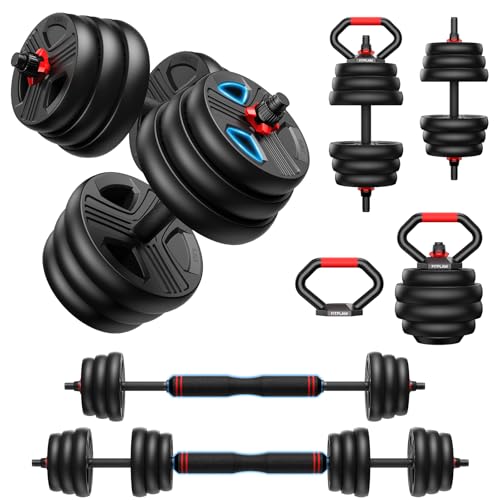
- Adjustable dumbbell set: Lets you make the small load increases that double progression depends on. Look for Bowflex SelectTech 552 or a comparable adjustable set. View on Amazon
- Lifting straps: Helpful for heavy pulling sets where grip would otherwise limit your back work. Harbinger Padded Lifting Straps are a common choice. View on Amazon
- Resistance bands: Useful for warm-ups and for adding a light accessory set on travel days. For options, see Best Resistance Bands for Home Workouts: 5 Sets Compared. View on Amazon
- Training log or app: A simple notebook works as well as any app. Recording every set is what makes progression possible.
FAQ
How long should I follow one routine before changing it?
Most people benefit from staying on the same program for 6 to 12 weeks. That gives enough time to see whether your lifts and measurements are moving in the right direction.
How many days per week do I need?
Three full body sessions per week is enough for most beginners to build strength and muscle. More days help only if you can recover from them and you have a specific goal that requires higher volume.
Can I build an effective routine at home?
Yes. The same principles apply with bodyweight exercises, bands or a single pair of adjustable dumbbells. See Home Workouts With Bodyweight and Minimal Equipment for examples.
Should I train to failure?
Not on every set. Training close to failure on your last set of a few key exercises is useful, but most work should stop with one to three reps in reserve.
How do I know if my routine is working?
Track your loads, reps, body weight and a few simple measurements every two to four weeks. If your main lifts or performance numbers improve over that period, the routine is working.
What if I miss a workout?
Do not double up the next day. Resume your normal schedule and, if you missed more than a week, reduce loads by about 5 to 10 percent for the first session back.
Is it safe to start a new routine if I have an injury or medical condition?
Consult a doctor or licensed physical therapist before starting a new program, especially if you have joint pain, heart conditions, high blood pressure or recent surgery.
Where can I find beginner-friendly options?
If you are just starting, read Beginner Workouts: How to Start and Progress Safely before building your own plan.
Conclusion
Effective routines come from clear goals, a split that fits your week, well-chosen exercises, and a progression method you apply consistently. Start with the sample plan above, track every set, and make small, deliberate increases in load or volume. Give the program six to twelve weeks before judging it, and adjust based on your data rather than on how any single workout feels.